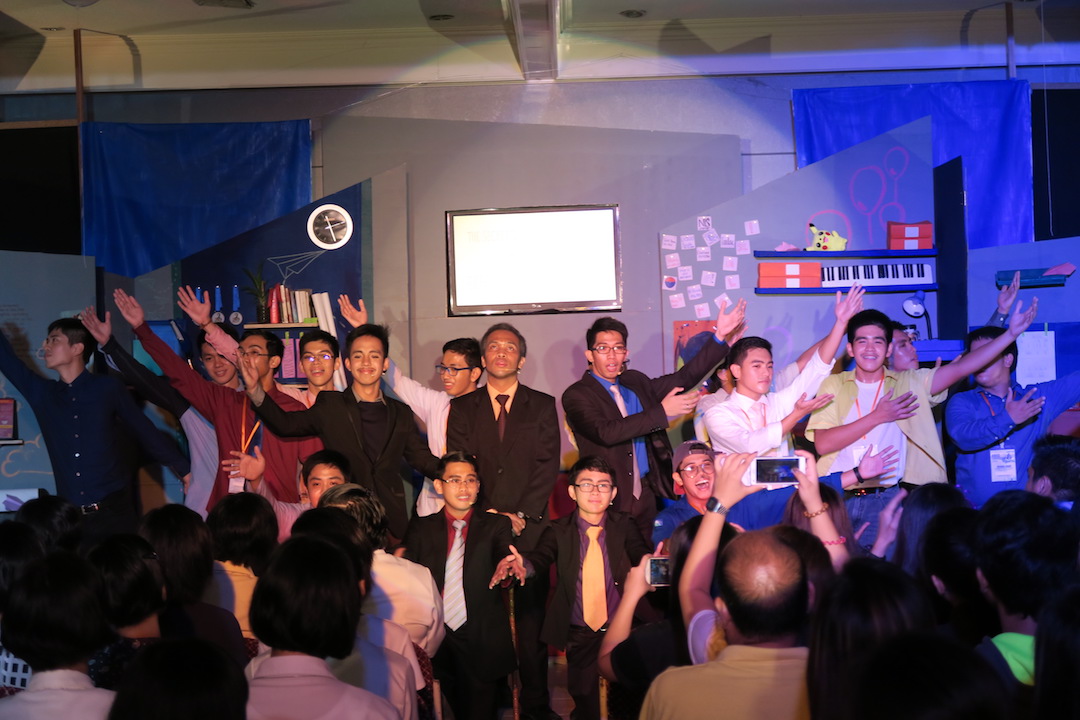
It is not often if ever that I am enthused about musicale productions that are locally scripted and produced. And so with some reluctance I was constrained to watch what I thought be one more of the same. My original intention was to close my eyes and sleep through it, if I could. What the heck, it was in Tagalog which I hardly understand and my eyes, not any more young and, in the bargain, also afflicted with glaucoma are photophobic. But as the lights came on after the initial prayer and customary singing of the National Anthem, I remained captivated till the rousing finale. What kept me so, you may ask?
To start with the stage setting, in ingenuous originality, opening with whiteboard screens to masterfully draw you into the whole drama. The constraints of space and distance were overcome with masterful lighting and a color scheme that was not just pleasing. No part of the setting was stridently glaring. Each part blended into a harmonious whole which allowed the characters to pop in and out as if actually materializing from wherever the flow of the play called for them.
The music, taken care of with just a key board lightly accompanied by drums , did not seem to have been written for or by amateurs. There was a professional touch about it. The gave scope for the untutored talent to enliven the lyrics in a declamatory style with clarity and impact. To make sure that the lyrics came home, perhaps also to cater for those unfamiliar with Tagalog, there was a projection screen craftily placed at the center back of the stage. The director confined himself to using the limited human resources of the pre-novitiate (just 34 odd aspirants and postulants) without outside support apart from one beautiful video of a solo dancer who depicted prayerfully the theme of Mary being assumed into heaven.
The singing of the performers would have supposed that they had been actually gifted with a reasonably good voice. However those, who are into the inner secrets of the place, know this was not actually the case. Two or three of the performers have been gifted with passable voices. The director however had called on almost every one of the small cast of twenty plus to voice a line or many more than a line at some point or other. His coaching and trust paid off and there were no mishaps. The audience could never have known what were the original resources of the musical repertoire both in composition and in choralization. Each performer came out in almost crystal clear tones that never came out jarring.
The stage effects were simple yet effective as once again the director and his crew made use of the ordinary to bring out the extraordinary. The spot lights were used to keep the performers seemingly very close to the audience in close ups that were not actually there. And added effects like paper planes flying in and out kept the theme of assumption in clear focus.
The original idea of an elevator that brought the actors from one level of the dramatic venue to another helped to give reality to the change of scenes without the usual interruptions of lights off and lights on. It also brought smiles to the faces of the onlookers as the elevator-man called out for people to move up or down in the levels of performance. To make certain that everyone knew where the setting was the floor number was lit up brightly.
Bro. Paul Dungca was the playwright and the director. He conceived the Assumption of the Blessed Virgin as God’s way of doing great things for Mary, lifting up the humble and putting down the proud. He capsulated this theme into the story of a family where some siblings in their different roles displayed callous arrogance in contrast to the simply ordinary brother put down despised and blamed by his kuyas but eventually recognized and exalted by the father to the chagrin of his brothers. This simple theme was developed with a lively dialogue that gripped the interest of the audience from start to finish. The well thought out script was often dramatized in operatic style with dance and song skillfully performed by the cast with the assistance of a small group of choreographic dancers. Again the choreographic dances were able to utilize the limited space with amazing effect. There seemingly was not a dull moment for the audience. No one left in between and most were sitting on the edge of their seats their eyes riveted on the scene as they drank in the flow of music and words.
The musical score was so arranged as to overpower completely from the start. This perhaps was difficult to sustain in certain parts of the second half of the performance. Also in the opinion of this critic, certain dramatic sequences were a little drawn out. With a little editing and cutting, the musicale could be telecast to a wider audience in need of such food for soul and mind.
A word of appreciation is in order for the director who brought out the best from his cast and boosted their egos so effectively that they made use of the lime light to project overwhelming strains of melody, captivating choreographic dances and clear diction that enriched the audience while it kept them entertained. A word of appreciation for the cast who were unstinting in shouldering this heavy responsibility without making it a burden even though it demanded time and effort over and above the call of their normal duties. The support of the technical crew headed by Bro. James Gomez was unstinting and unflagging.
The performance, in Salesian terms, was able to reach the goal of the theatre as understood by Don Bosco. It entertained while it educated, it enhanced confidence and self-esteem while it brought about, even though unobtrusively, a catharsis in audience and more so in the performers. Don Bosco would definitely and emphatically say, Bravo!
by Fr. Joseph Fernandez, SDB